
Key terms in this article
What is WLR?
WLR (Wholesale Line Rental) is the legacy Openreach product that lets resellers sell traditional analogue or ISDN lines on the PSTN copper network. Openreach has stopped selling new WLR lines and is staging price rises through 2026.
What are the Ofcom pounds-and-pence rules?
The Ofcom pounds-and-pence rules are General Condition C1.18, in force since 17 January 2025. They require any in-contract price rise on residential telecoms to be stated as a specific pounds-and-pence amount at point of sale, not as a percentage tied to CPI or RPI.
What is the PSTN switch-off?
The PSTN switch-off is the planned shutdown of the UK copper telephone network at the end of 31 January 2027. Every voice service must run over an IP network from that point.
What Are the 2026 WLR Price Rises?
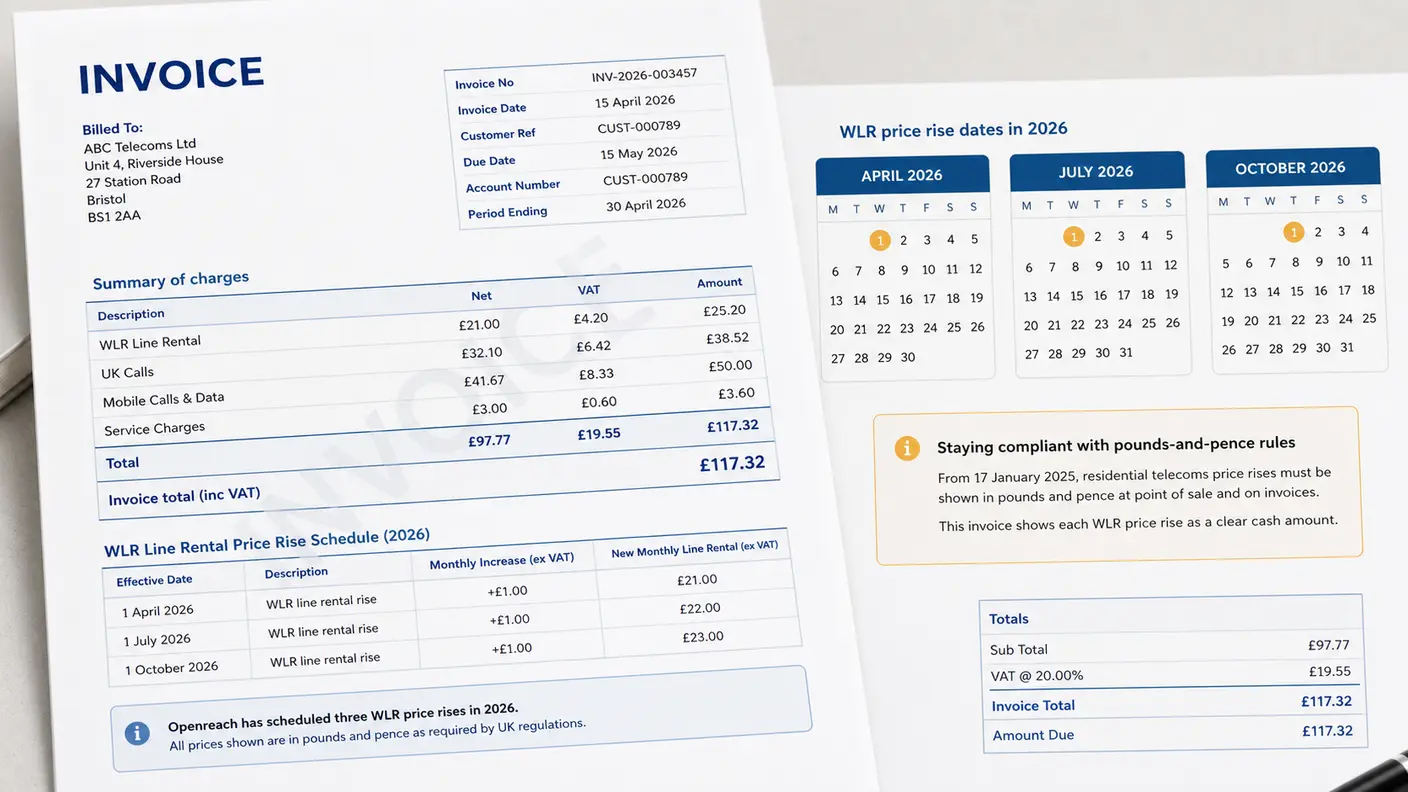
Openreach has staged three Wholesale Line Rental price rises across 2026 to push remaining customers onto IP voice services before the 31 January 2027 PSTN switch-off. The rises take effect in April, July and October 2026 and apply to most of the WLR price book.
If you carry any WLR product through wholesale, your customer invoices will move three times this year. The April rise is the gentle one. The October rise is the one customers complain about. Resellers who plan the communications now save the support burden later.
Key Takeaways
- Openreach has confirmed staged WLR rental rises in April, July and October 2026
- The intent is to accelerate migration off copper before the 31 January 2027 cut-off (Openreach, 2026)
- Ofcom’s pounds-and-pence rules apply to any residential in-contract price rise you pass on (Ofcom GC C1.18 guidance, 2025)
- Reseller margin on WLR is already thin; absorbing the rises usually is not viable past July
- Customer-facing wording is best drafted once and reused for all three waves
- Many WLR customers are upgrade candidates for SIP and hosted PBX
What Drives the Rises
Openreach is not raising WLR rentals because copper costs more to run. It is raising them because the regulator and Openreach want the migration to IP to finish on time. The number of customers still on the PSTN at the start of 2027 has to be small enough for the residual exceptions process to handle. Price signals do most of the work.
For a reseller, that means three forced conversations a year. Every conversation is an opportunity to convert a legacy line into a hosted PBX seat, or at least into a SIP trunk. Every conversation is also a risk: the customer who hears “your line is going up again” three times in seven months may decide to shop around.
What to Put on the Invoice
Three things make the difference between a calm renewal and an angry phone call.
Show the old price, the new price, and the date of change. Do not bury it in a line-item rate change. A separate paragraph on the cover sheet works. So does a one-line annotation on the line item itself.
State the change in pounds and pence. Even if the customer is a business, the wording habit from the residential market reads as fair. If your contract allows you to pass on RPI plus a margin, translate that into pounds before you send the invoice. This is also what Ofcom expects on residential products. See our PSTN switch-off guide for where the residential rules fit alongside the migration pressure.
Explain why, briefly, once. “Openreach has increased the wholesale price of this line. We are passing the change on. The price will rise again in July.” That is enough. Long explanations look defensive.
Annual RPI Rises Are a Separate Conversation
A lot of reseller contracts have their own annual price-rise clauses, usually tied to RPI or CPI plus a margin. These are not driven by Openreach. They sit on top of the WLR rises and they hit on a different date.
From our experience: the trickiest conversations are not the WLR rises. They are the customers who get an RPI uplift letter in March, a WLR pass-through in April, and a renewal quote in May. Three letters in three months feels like aggression even when each one is justified. If you can sequence them, sequence them. If you cannot, lead with the WLR rise because that one has an external reason.
The pounds-and-pence rules apply to any in-contract price rise on residential services, including the RPI-linked ones. If your contract still says “RPI plus 3.9%”, that contract wording is fine for existing customers but it cannot be used at point of sale for new residential customers. The billingplatform.uk post on configuring pounds-and-pence price rises covers how to set up the new wording in the billing platform.
When to Renegotiate Contracts
Renewal sequencing matters more in 2026 than usual. A few patterns we see working:
- Customers approaching renewal in Q2 2026 are good candidates to move straight onto a SIP-and-hosted-PBX package. The migration cost is partly offset by the WLR rises they would otherwise absorb.
- Customers on long-term contracts that lock in WLR pricing should still expect the wholesale uplift passed through, but the conversation should explicitly avoid suggesting migration is contractually required.
- Multi-site customers benefit most from a single migration date. Three sites moving in three different months produces three different invoice patterns and three sets of support questions.
What Happens After October
By November 2026 Openreach engineers will be visibly stretched. By December the lead time on copper-related work will be long enough to be a real planning factor. Customers who delay until 2027 will pay more, wait longer, and have less choice over the replacement product. Anything you can land between April and August will be smoother than anything you try to land in November.
Watch out for wholesale port-out charges that arrive weeks after a customer has actually moved; the porting fees pass-through guide covers what to put in your contracts to handle them cleanly.
How SAFE Billing Platform Handles It
The practical question for resellers is “how do I get the new rate onto the right customers’ invoices on the right date without spending a week on it?” SAFE Billing Platform applies tariff changes by effective date with pro-rating handled automatically, so the same workflow runs for the April, July and October cycles. Wording and contract clauses sit with you, but SAFE’s Ofcom-classification and correspondence-generation tools help you produce per-customer price-rise letters from your own template against the tariff change. The billing run guide walks through the monthly cycle, and the customer accounts guide covers the bulk-change tools.
Frequently Asked Questions
Do I need to tell customers about WLR price rises under Ofcom rules?
If the customer is on a residential contract, yes. Ofcom General Condition C1.18, in force since January 2025, requires in-contract price rises on residential telecoms to be stated as a specific pounds-and-pence amount at point of sale. For each of the three 2026 WLR rises you pass through, you need to issue a notification in pounds and pence before the change takes effect. Business contracts are not directly in scope, but clear wording is good practice regardless.
What are the actual WLR price increase amounts in 2026?
Openreach publishes the specific increase amounts in its pricing notices, available through the Openreach customer portal for registered resellers. The exact figures vary by WLR product type. Check the current pricing notice for your specific products before drafting any customer communications, since the amounts you quote to customers must match the actual change on the invoice.
What happens to WLR after January 2027?
Openreach will stop carrying voice traffic on the PSTN at the end of 31 January 2027. Any WLR product still in service at that point will go dark. There is no extended WLR service after that date. All customers still on WLR must migrate to an IP voice product, such as a SIP trunk or hosted PBX seat, before the cut-off.
If you would like a walk-through against your own tariff book and customer list, the contact form is the quickest way in.