
Key terms in this article
What is the PSTN?
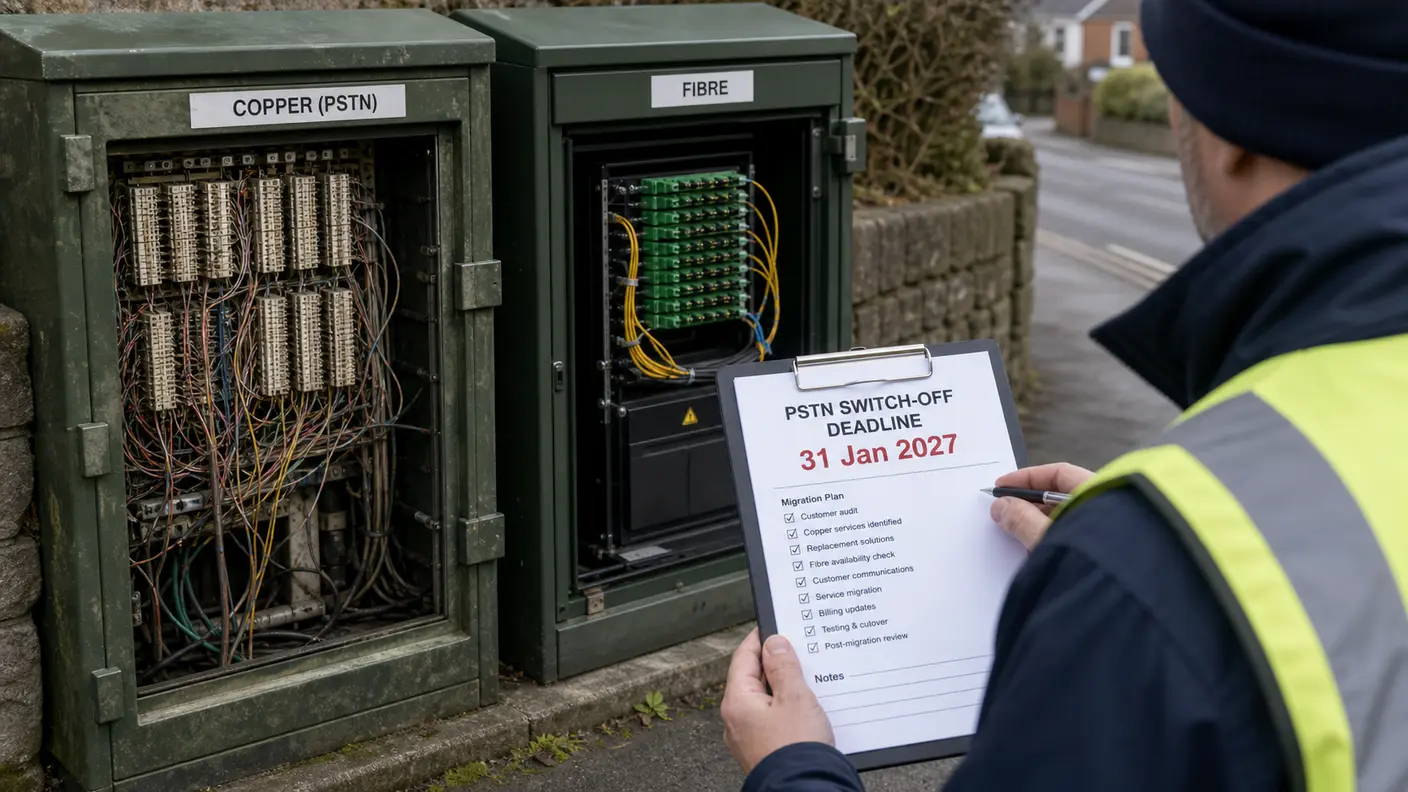
PSTN (Public Switched Telephone Network) is the copper-line telephone network UK homes and businesses have used since the 1870s. Openreach is retiring it. After 31 January 2027, every voice call must travel over an IP network instead.
What is WLR?
WLR (Wholesale Line Rental) is the legacy Openreach product that lets resellers sell traditional analogue or ISDN lines on the PSTN. Openreach has stopped selling new WLR lines and is staging price rises through 2026 to push the remaining base onto IP.
What is VoIP?
VoIP (Voice over Internet Protocol) is voice calling carried over the internet rather than a copper line. SIP trunks and hosted PBX seats are both VoIP products. After the switch-off, almost every UK voice service will be VoIP.
What is a SIP trunk?
A SIP (Session Initiation Protocol) trunk is a virtual line that carries voice calls over IP. One trunk can carry many concurrent calls. Resellers usually charge per channel, plus per-minute call usage and any bundled minutes.
What is Ofcom?
Ofcom is the UK communications regulator. It sets rules on billing accuracy, contract notifications, and price transparency under its General Conditions, all of which apply when you move customers from PSTN to IP services.
What is the 2027 PSTN Switch-Off?
The PSTN switch-off is the planned shutdown of the UK’s copper telephone network. Openreach will stop carrying voice traffic on the PSTN at the end of 31 January 2027. Every voice service must run over an IP network from that point.
If you are a UK telecoms reseller, you do not need a copper migration plan unless you sell legacy lines. You do need to understand what your customers will ask, because their other suppliers are going to disrupt them whether you sell them voice or not.
Key Takeaways
- The PSTN fully switches off on 31 January 2027, with no flexibility on the date (Openreach, 2026)
- The UK has more than 5.5 million SMEs, many of which still rely on legacy systems exposed to the switch-off (channellife.co.uk, 2026)
- Only 18% of smaller businesses report having a solution ready (channellife.co.uk, 2026)
- Openreach has staged WLR rental rises in April, July and October 2026 to push remaining customers onto IP (Openreach pricing notice, 2026)
- Door entry, lift phones, fire panels, alarms and payment terminals are the easy-to-miss services that fail when copper dies (see our hidden costs guide)
- Engineer and equipment lead times tighten through late 2026 as the deadline approaches
- Most modern IP voice products charge per channel and per seat, which changes how the bill looks compared to a flat WLR line rental
Who Is Affected?
Anyone whose service still touches the PSTN. That includes:
- Customers on analogue lines for voice
- Customers on ISDN30 or ISDN2e
- Premises with broadband delivered over the same copper pair as a voice line
- Devices that quietly dial out: alarms, lifts, fire panels, telecare units, EFTPOS card terminals
- Anything on a Multiline service
If your reseller business is already VoIP-first, your direct exposure is small. Most of our customers sit firmly in that camp. But your customers are still small businesses, and small businesses still have analogue lifts, alarm panels and ageing card machines. Those will fail. The phone calls about them will land somewhere.
Why Resellers Should Care, Even If You Do Not Sell Landlines
Three reasons.
First, prospect flow. Through 2026 a lot of small businesses will discover that their current voice provider cannot move them to IP cleanly, or quotes them a number their accountant does not like. Those businesses will go shopping. Some of them will land on a reseller selling SIP trunks and hosted PBX.
Second, billing complexity. A line on a PSTN bill is one product, charged at a flat rental, with calls itemised. A line on an IP bill is a channel on a trunk, possibly bundled with minutes, sometimes sold per seat, sometimes capacity-based. End customers find the new format harder to read. Resellers who explain it well keep the relationship. Resellers who do not, lose it at renewal. Our tariff and pricing guide covers how SAFE Billing Platform rates each of these models.
Third, regulatory overlap. Ofcom’s pounds-and-pence rules on in-contract price rises took effect in January 2025. Any IP voice product sold to consumers, and a fair amount sold to small business, must express future price rises in pounds and pence at point of sale. The billingplatform.uk post on configuring pounds-and-pence price rises goes through what that looks like in practice.
What Changes on the Bill
If your customers move from PSTN to a SIP-and-hosted-PBX setup, three things on the invoice usually change.
Rental becomes channels and seats. A traditional line is one rental charge. A SIP trunk has a per-channel rental for concurrency, plus a per-seat charge for each hosted PBX user. A ten-person office might have eight channels and ten seats. That is two line items instead of one. For the detail on how SAFE rates each of these models, see the SIP trunks and hosted PBX billing post on billingplatform.uk.
Inclusive minutes show up. PSTN customers were used to seeing every call itemised. Hosted PBX packages often include UK landline and mobile minutes. Itemisation still appears, but the per-call charges look like £0.00 against bundled allowances. Some customers find this reassuring. Others get suspicious. Worth flagging in the cover letter.
Number rental becomes optional. On PSTN, the line and the number were one thing. On IP, you rent numbers separately, often in DDI ranges. If your customer ports a block of numbers in, expect questions about how that block appears on the bill.
From our experience: customers who have been on PSTN for fifteen years expect a single line item for “phone”. Showing them eight channels, ten seats and a DDI range on the same invoice without a cover note generates phone calls. A short PDF that maps the old line to the new components prevents most of them.
The 2026 WLR Price Increase Schedule
Openreach has staged three WLR rental rises through 2026: in April, July and October. The intent is straightforward: push every remaining copper customer onto IP before the hard cut-off. We cover the detail in WLR price rises April, July and October 2026.
If you carry any WLR through wholesale, expect the customer-facing impact to land in two waves. The April rise will be the first one people notice on the invoice. The October rise is the one that hurts. Resellers using the SAFE Billing Platform can roll Openreach uplifts into customer tariffs in advance and notify customers in pounds and pence so the price-rise wording satisfies the Ofcom rules.
What Stops Working When Copper Dies
The voice line is the obvious one. The hidden ones are the problem. A non-exhaustive list:
- Lift emergency phones: must be replaced or fitted with a battery-backed analogue terminal adapter
- Door entry systems with dial-out
- Monitored intruder alarms
- Fire alarm panels that auto-dial the monitoring centre
- Telecare alarms (red button) in residential and supported housing
- Older card payment terminals
- Faxes, scanner-to-fax, franking machines
- PDQ machines for hospitality and retail
The PSTN hidden costs post goes through each of these in more detail. The short version: when a small business asks you about voice, ask them about the alarm panel too. Most will not have thought of it.
What to Do Through 2026
A practical sequence for a reseller who wants to be ready, not panicked.
1. Audit your customer base. Even if you are VoIP-only, check whether any tariffs you sell still reference WLR pricing. Tag the customers exposed. There are usually a few historical accounts.
2. Pre-write the price-rise comms. Whatever you do in April, you will be doing again in July and again in October. Draft the customer-facing wording once, build it into your billing run, then send it three times. If your billing system supports pounds-and-pence notifications natively, use that.
3. Identify upgrade prospects in your existing base. Customers on smaller hosted PBX packages may justify more channels by Q4. Migration year is upgrade year.
4. Brief your support team on the hidden-services question. Lifts, alarms, card terminals. They will get asked even if they did not sell them. Have a one-line answer that points the caller at their installer.
5. Plan capacity for late 2026. Engineers, ported number lead times and even hardware availability tighten as the deadline approaches. Anything you want done in October that you can do in August, do in August.
How SAFE Billing Platform Helps
A few specifics. SAFE handles the rating differences between PSTN-era and IP products in the same billing run, so a mixed estate is straightforward. Inclusive minutes, per-channel and per-seat charges sit alongside legacy rentals on one invoice. Tariff changes apply by effective date with pro-rating handled automatically, so the April, July and October 2026 uplifts land cleanly on the next invoice cycle. For the customer-facing side, SAFE includes Ofcom-classification and correspondence-generation tools to help you produce per-customer price-rise letters from your own wording against the tariff change. The billing run guide walks through the monthly cycle in full.
Frequently Asked Questions
When exactly does the PSTN switch off?
Openreach will stop carrying voice traffic on the PSTN at the end of 31 January 2027. There is no flexibility on the date. Every voice service must run over an IP network from 1 February 2027. New WLR products stopped being available years ago; what remains is the existing installed base being migrated before the cut-off.
Do I need to do anything if I only sell VoIP already?
If your customer base is already entirely on SIP trunks and hosted PBX, your direct exposure to the switch-off is small. But your customers are still small businesses, and small businesses still have analogue lift phones, alarm panels and card terminals connected to the copper line. Those will fail. The calls about them may still land with you as the voice provider, so knowing the basics of what else is on the line is useful even for VoIP-only resellers.
What happens to WLR lines after January 2027?
Any Wholesale Line Rental product still in service at the end of 31 January 2027 will stop carrying calls. Openreach will not extend the deadline for individual customers. Any customer still on WLR at that point must migrate to an IP voice product. The three staged WLR price rises in 2026 are Openreach’s mechanism for encouraging migration before the cut-off.
If you want to see how a specific mix of customers and tariffs looks under SAFE, get in touch through /contact/. The PSTN deadline is firm. The good time to plan for it was twelve months ago. The next good time is the rest of 2026.