
Key terms in this article
What is the PSTN?
PSTN (Public Switched Telephone Network) is the UK copper telephone network. Openreach will switch it off at the end of 31 January 2027. After that date, any device that dials out on a copper line will stop working.
What is an analogue terminal adapter?
An analogue terminal adapter (ATA) is a small box that lets an analogue device, such as a lift phone or alarm panel, work on an IP network. It plugs into the broadband router and presents a normal phone socket on the other side.
What is BS EN 81-28?
BS EN 81-28 is the British and European Standard that covers remote alarm systems on passenger and goods-passenger lifts. After the PSTN switch-off, a lift emergency alarm must still meet the standard, which usually means a battery-backed IP or SIM-based solution rather than the old analogue line.
What Stops Working When the PSTN Switches Off?
When Openreach switches off the PSTN at the end of January 2027, every device that dials out over a copper line stops working. The desk phone is the obvious one. The expensive ones are the devices nobody remembers are connected: lifts, alarms, fire panels, card terminals, telecare alarms, sometimes the fax machine in the back office.
If you are a small business owner, the bill for the desk phone is usually small. The bills for everything else are larger and harder to predict. If you are a telecoms reseller, this is the question your customers will start asking through 2026.
Key Takeaways
- The PSTN cut-off is fixed at the end of 31 January 2027 (Openreach, 2026)
- Lift emergency alarms must meet BS EN 81-28 and need battery-backed IP or SIM-based solutions, not just a new handset
- Monitored intruder and fire alarm panels often need a SIM or IP module
- Older EFTPOS card terminals fail without an upgrade or a 4G replacement
- Telecare alarms in residential and supported housing need urgent assessment (TSA digital shift information, 2025)
- The UK has around 5.5 million SMEs and industry reporting warns many remain exposed to the switch-off; only 18% report having a solution ready (channellife.co.uk, 2026)
- Most of these devices were installed years apart by different suppliers; the small business owner is the only one with the full list
Lift Emergency Phones
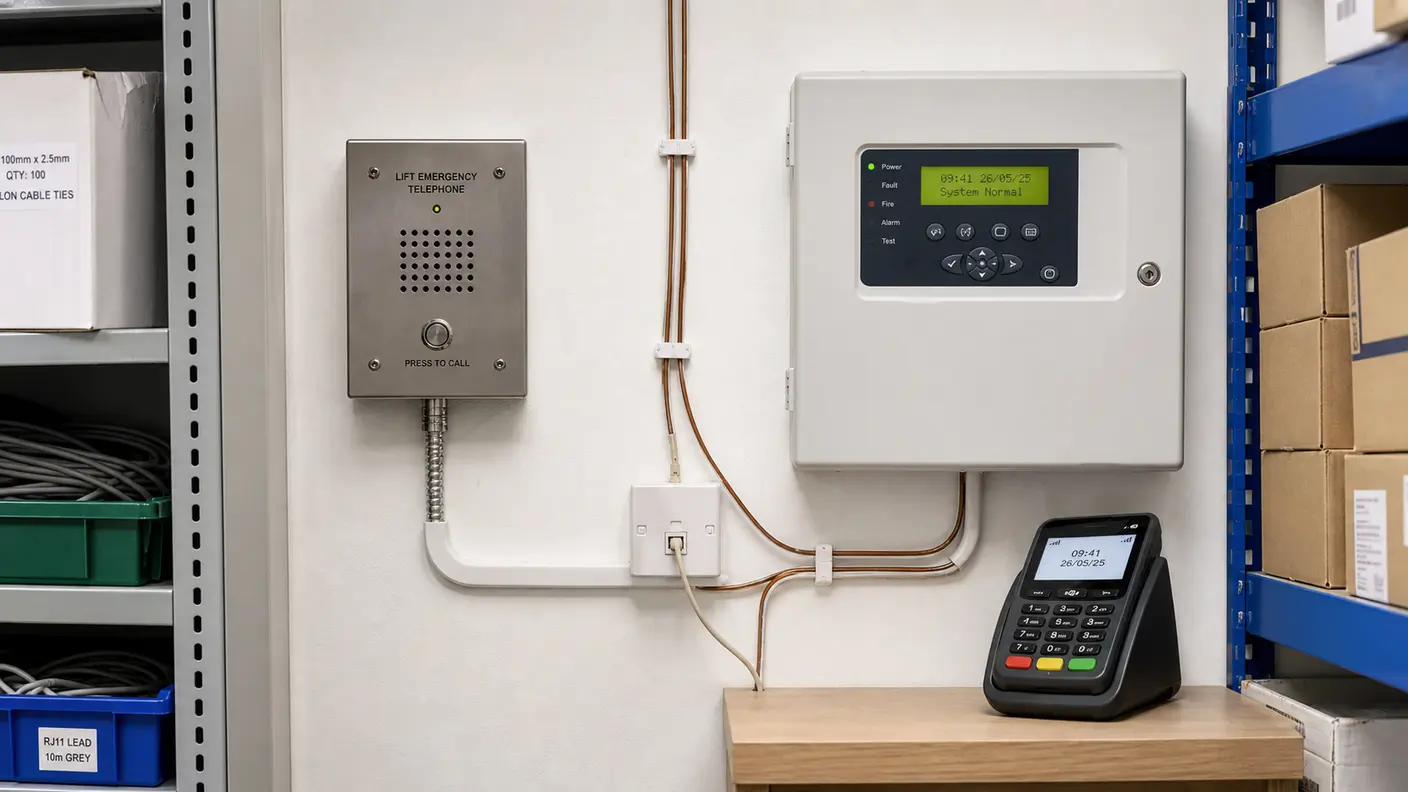
The lift phone is the highest-risk device on most small-business sites. If the lift is in service, the alarm must work, by law. The British and European Standard BS EN 81-28 sets out what counts as acceptable for remote alarms on passenger and goods-passenger lifts. A copper analogue line connected to a third-party monitoring centre is the traditional setup.
After the switch-off, that line is gone. The replacement is usually a battery-backed IP solution or a SIM-based device, with backup power good for at least an hour. Costs vary, but expect a four-figure capital spend per lift and a small recurring monitoring fee. Lead times from lift maintenance companies are already lengthening.
If you sell hosted PBX or SIP trunks, you will not be the one fitting the lift phone. You should, however, know enough to point the customer at their lift maintenance provider and remind them this is not the desk phone problem.
Monitored Intruder and Fire Alarm Panels
Monitored alarms dial out over the phone line to a central monitoring station, usually following a signalling standard such as EN 50136. Older panels use the copper line. Newer panels use IP, GPRS, or both as a dual path.
The risk is that the customer does not know which panel they have. Many small businesses have not replaced the alarm in a decade. The installer’s contract is still in place but the contact details on the engineer’s sticker are out of date. The first time anyone discovers the panel is on PSTN is when the line stops working.
For commercial premises, the alarm path is usually a condition of the insurance policy. A failed path can mean a void claim. This is worth flagging to customers along with anything else you send about the switch-off.
Card Payment Terminals
The dial-up card terminal era is mostly over, but mostly is not all. Hospitality venues with PDQ terminals, small retailers using older portable card readers, and a long tail of franchise units still have terminals that dial home over a phone line. These will fail.
Replacement is usually straightforward, since most modern terminals are IP, Wi-Fi or 4G, but the customer does need a working replacement on the day, and the merchant services provider sets the pace. Customers who buy time-sensitive things (concert tickets, restaurant covers) cannot afford a card-terminal outage on a Friday night in October 2026 because they left it until then.
Telecare and Personal Alarms
Telecare alarms, the red-button pendants used by older and vulnerable people in residential and supported housing, are the single highest-risk PSTN device in the UK. The Technology Enabled Care community has been preparing for this for years, but a meaningful number of analogue alarms are still in service.
If your customer is a housing association, a domiciliary care provider, or any business that owns telecare equipment as part of its service, the migration is not optional. Independent of the PSTN switch-off itself, the telecare digital shift has its own programme of replacements. Customers should already be in conversation with their alarm supplier and their local authority.
Faxes, Franking Machines, Door Entry, Other Oddities
The long tail. Faxes are almost gone but not quite; solicitors and a chunk of healthcare still send them. Franking machines that dial home for credit top-ups. Door entry systems with audio call out. Auto-dialler systems on roller shutters. The cleaner’s intercom in the warehouse.
From our experience: the device list a small business builds in February is always missing one item. Usually it is a door entry intercom, a building management system that dials out a fault alert, or a fire alarm in a sub-let area that is technically the landlord’s problem. The fix is normally easy. The discovery is the painful bit. Ask the question now, not in November 2026.
What to Do, Practically
A short checklist a reseller can hand to a customer.
- Walk every site. Look for anything that dials out: lift, alarm, fire panel, card terminal, telecare, door entry, fax, franking machine.
- For each, find the installer or service provider. Ask them in writing whether the device will still work after 31 January 2027.
- For commercial alarms and lifts, check the insurance policy and the maintenance contract.
- Book the upgrades for the first half of 2026 if possible. By the second half, engineer lead times tighten significantly.
- Keep a list. The next person to ask the question, whether the new office manager, the insurer or the auditor, will need it.
How This Fits With the Voice Conversation
If you are migrating a customer’s voice to SIP and hosted PBX, the visible saving is on the phone bill. The hidden cost the customer sees in 2026 is everything else on the copper line. Resellers who acknowledge both keep the customer’s trust through the migration. Resellers who sell the voice replacement and leave the rest as “not my problem” will be the ones the customer blames in February 2027.
The PSTN switch-off resellers’ guide covers the wider migration. The WLR price rises through 2026 post covers the staged cost increases that push the timing.
Frequently Asked Questions
Will my monitored fire alarm stop working after the PSTN switch-off?
Most monitored intruder and fire alarm panels that dial out over a copper line will stop working after 31 January 2027. Whether yours is affected depends on when the panel was installed and how it communicates with the monitoring centre. Panels using IP or GPRS dual-path signalling are already compatible. Older panels using only the analogue phone line need a SIM or IP module added, or a full replacement. Ask your alarm installer in writing before the end of 2026.
Do card payment terminals need replacing when copper goes?
Some do and some do not. Most modern terminals already use IP, Wi-Fi or 4G and will be unaffected. Older dial-up terminals that connect over the phone line will fail when the PSTN switches off. If you are unsure, check with your merchant services provider. The risk is a terminal outage at the worst possible moment, so it is worth confirming before late 2026.
How much does it cost to replace a lift emergency phone?
Costs vary significantly depending on the lift age, the monitoring contract and whether a straight analogue terminal adapter can replace the existing connection or a full lift-phone unit is required. Expect a four-figure capital spend per lift in most cases, plus a small ongoing monitoring fee. Lead times from lift maintenance companies are already lengthening as the switch-off approaches, so booking early matters.
If you want a billing platform that handles a mixed estate of legacy lines and new IP services on the same invoice while the migration is in flight, get in touch.